
ESP – ENG
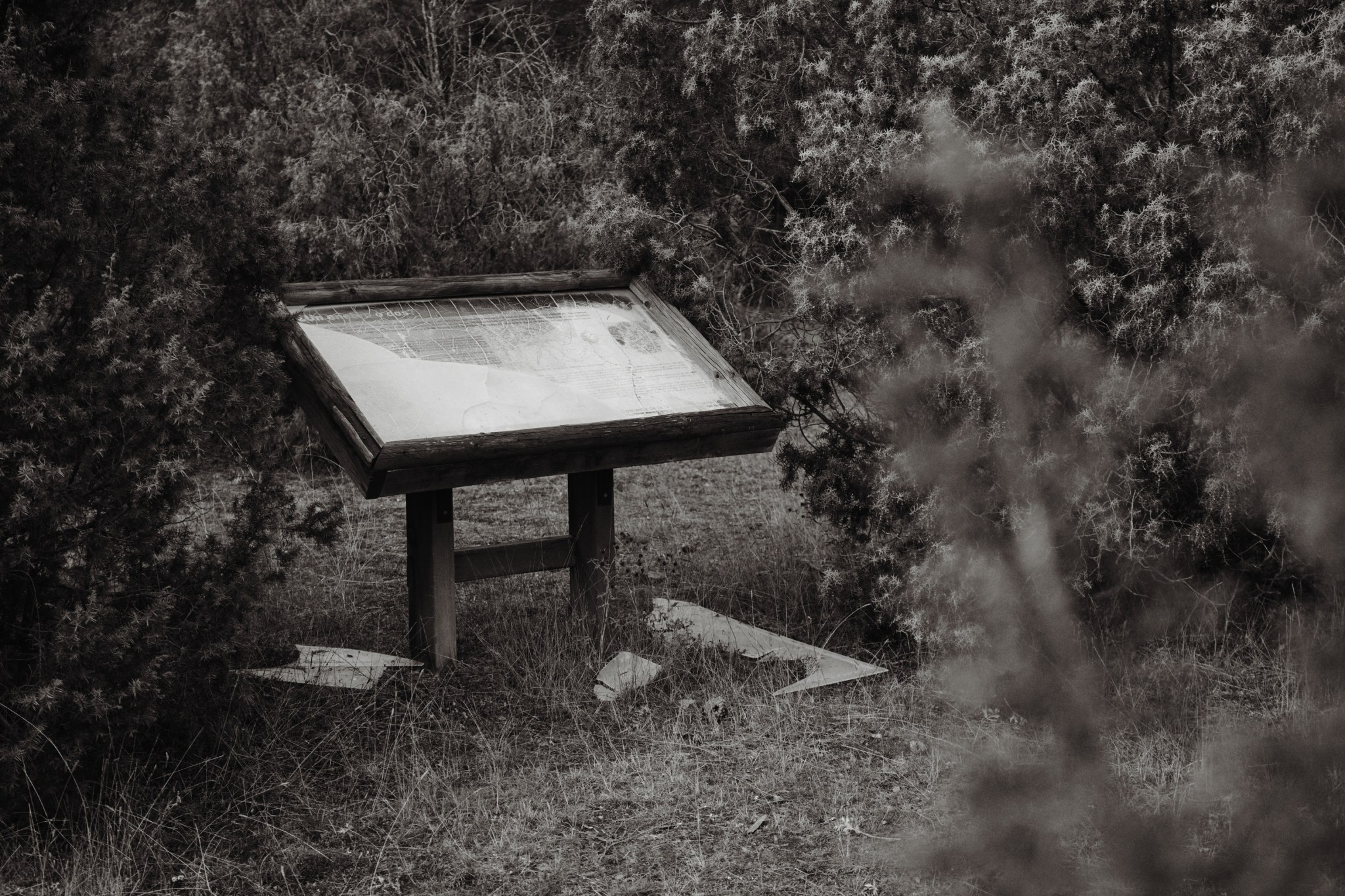
I’m on one of those dawn walks I love so much, looking for a photo. Usually, I let myself go without a fixed idea of what my lens will capture, simply adapting to the light and the conditions of the day. I adore that feeling. However, this morning, with temperatures still below zero, my eyes aren’t focusing on the light frost or the first rays of sun. Within minutes, I’ve already come across the remains of three abandoned information panels, where it’s no longer possible to even imagine what they were supposed to inform us about. They’re merely tangles of wood, metal, and yellowing acrylic that were once a village’s hope: “Perhaps this little themed trail will attract visitors to the village, and they’ll stop by the bar for a quick coffee.” That hope’s now a distant memory, transformed into indifference over the years.

Local footpaths, botanical trails, nature paths, themed routes, hiking or cycling routes—dozens of them are inaugurated every year across the length and breadth of our country. Promoted by town councils, districts, provincial or regional bodies in search of national or European grants and aid, but (let’s be clear) always executed and designed with the best of intentions: outreach, protection, or bringing life to the villages. Throughout all these years, both in my professional work and in this project, I’ve met many people working at these different levels of administration, and I’ve never doubted the good faith with which these infrastructures are planned.
Yet, as I’ve said, while dozens of routes of this style are inaugurated every year, with their corresponding signage and information boards, dozens are also abandoned every year. Political changes, the end of plans, subsidies, or European programmes, or simply staff changes in one of these departments. Any of these reasons can spell the end of maintenance for projects that were once a source of excitement.
Maintenance. It truly could be said to be the cursed word. In any administration, it can be “relatively” easy to obtain funding to launch different types of programmes, even if it isn’t always so for some basic necessities in many of our villages. However, what can become a true odyssey is securing the budget lines necessary to perform even minimal maintenance on what has been built over a medium-to-long-term period.

This leads to at least two circumstances: over-signposting and what I call junk signs.
Over-signposting is a syndrome that affects a vast number of our natural spaces. All of us who enjoy outdoor activities have witnessed it to a greater or lesser extent. At crossroads, summits, and car parks, various signs and boards for hiking, cycling, horse riding, trail running, points of interest, or themed routes huddle together, often with a somewhat cluttered result.
But if we add a layer of neglect to that over-signposting, the problem worsens. Panels made of metal, plastic, or fibre; support structures that, at best, are made of wood; glass or acrylic protectors. These are materials that age very poorly outdoors, regardless of their quality.
All of this achieves, entirely unintentionally, the opposite effect to what was desired. If the original aim was to showcase a resource and create something useful for the village, the final result is exactly the reverse: instead of the positive effect of word-of-mouth, a negative one is achieved. Opinions about the poor state or the perceived negligence of the competent administration spread like wildfire, and visitor numbers can end up even lower than before the project was implemented. I’ve experienced this several times in recent years: comments from foreign visitors returning to their countries with a bitter taste in their mouths due to a bad experience stemming from the lack of maintenance of certain infrastructures or cycling routes.

In some villages, it’s the residents themselves who’ve taken it upon themselves voluntarily—and at their own expense—to try and bring abandoned routes back to life, or to extend their useful life as much as possible. While this is an admirable practice that highlights the human quality in our villages, that responsibility shouldn’t fall on the good faith of the neighbours. It isn’t the solution.
So, what tools do we have?
- Maintenance, maintenance, maintenance: Making progress in creating operational systems that allow this type of expenditure to be executed more easily.
- Decommissioning, or in other words: the rewilding of a space degraded by such an intervention. The same applies as in the previous point: it shouldn’t be an odyssey to find the administrative mechanism that allows it.
- Better planning: In this day and age, with current technology, continuing to signpost on the scale we’re seeing is simply “inefficient,” to put it mildly.
Because of all this, the perception administrations have towards what they build must change. Not long ago, one of them contacted me to ask how all of this at MontañosVacías worked or had been developed. After a detailed explanation—which I’m always happy to provide—they apologised by saying: “I’m sorry, that won’t work for my bosses; they need ‘something’ to inaugurate.”
REFLECTIONS
Whether we’re users, administrations, or signage companies, I believe it’s necessary to begin a profound reflection on this subject. Just as I’ve emphasised on other occasions the importance of raising awareness about acoustic noise, these abandoned installations represent a visual noise that neither our land nor its inhabitants deserve.
From a user’s point of view, we must reflect on the way we discover, plan, and travel through the places we visit. If we find discrepancies between our expectations and what we see around us, these can be a good catalyst for a constructive conversation or a formal request to the relevant administrations in each case.
These administrations, in turn, must begin a reflection on past, present, and above all, future projects that may give rise to dynamics capable of gradually reversing this situation. Likewise, it would be highly appropriate for the companies in charge of these installations to take into account the usual and real life cycle of these projects, reflecting on their service offering and minimising long-term impact.
BELOW ZERO
That morning, still below zero, I left without any spectacular photos, but I did leave with these words you’ve just read. In the end, for me, photography and writing have the same mission: to convey emotions. In this case, those provoked by these abandoned signs, these forgotten signs… these junk signs.
Do you also know of cases in your area? I’d love to hear from you...
(Comments on the Spanish version of this article.)

Subscribe
Enter your email to stay updated.